If your agency needs new inquiries, “Google Ads or SEO?” is a budget decision with a few missing inputs. How much can you spend? Does the website already explain the office well? Can someone respond to inquiries? How long can you wait for evidence?
Google Ads buys exposure while the campaign runs. SEO improves the pages and search presence you maintain. GEO concerns visibility in AI answers and overlaps with that search work. Choose the next investment from your agency's situation, not a claim that one channel has replaced the others.
Compare what you are buying
| Approach | The work | Main limitation |
|---|---|---|
| Google Ads | Campaign setup, media, pages, measurement and ongoing management | Paid visibility and useful outcomes depend on continued spend and execution |
| Local and organic SEO | Useful pages, technical access, accurate local information and maintenance | Timing and rankings are uncertain; work does not guarantee traffic |
| GEO | Clear, supported information that search and AI systems can understand and cite | Inclusion and citations remain outside the agency's control |
SEO is not free simply because Google does not charge for an organic click. Writing, design, technical work and maintenance consume time or money. Ads are not automatically wasteful because the visibility is paid. Judge each by the useful business it can produce relative to its full cost.
Fix the common foundation first
All three approaches benefit from accurate agency information, a clear service offering and a dependable contact path. A visitor arriving from an ad, a map result or an AI answer still needs to understand the office and reach it.
Before allocating a growth budget, inspect the website on mobile, test form delivery and verify the phone route. Confirm who responds and what happens outside office hours. Make sure the agency's public claims and carrier references have the required review.
The website buying checklist can help you identify whether the public site needs a focused repair or a broader redesign. Avoid rebuilding a functional site solely because a channel salesperson requires a new one.
Favor a paid test when the question is specific
A controlled Search campaign can be useful when the agency has an approved service, a relevant destination, a budget it can risk and staff who can review inquiries. The test should answer a concrete question, such as whether a particular product and territory can produce qualified opportunities at an acceptable cost.
Do not spread a small test across every service and location. Start with a manageable scope and define the stopping rules. Include management fees in the economics, and avoid assuming that future renewals will make an otherwise weak test profitable.
Use the Google Ads budget model before deciding on media spend. If the agency cannot fund the test and its operating commitments, reduce the scope or postpone the launch rather than treating advertising as guaranteed cash generation.
Favor organic work when useful information is missing
If the site has inaccurate office details, weak service pages or no explanation of the agency's contact process, improve those first. Maintain the eligible Google Business Profile and build pages that answer real customer questions.
A content plan should follow the agency's actual services and the questions its staff can answer accurately. A generic stream of insurance definitions may attract readers with no reason to contact the office. The content-planning guide shows how to connect questions to meaningful page types.
Organic work also needs measurement. Review impressions, relevant visits and useful inquiries where available, while acknowledging attribution limits. A higher article count is not itself a business outcome.
Treat GEO as part of the publishing discipline
Google's AI-search guidance says its usual SEO fundamentals remain relevant and does not require special AI markup or files. That makes “GEO is all that matters” a poor reason to abandon a channel without examining your own business.
Publish specific answers, supported claims, real identity and current information. Use tables or diagrams when they clarify a decision. Keep important explanations in accessible page text rather than hiding them inside an image or an interactive component.
Our AI-search guide explains how to audit facts and observe citations without claiming control over an answer engine. Do not buy a guaranteed-citation package or assume a special text file replaces useful pages.
Allocate effort to the next useful decision
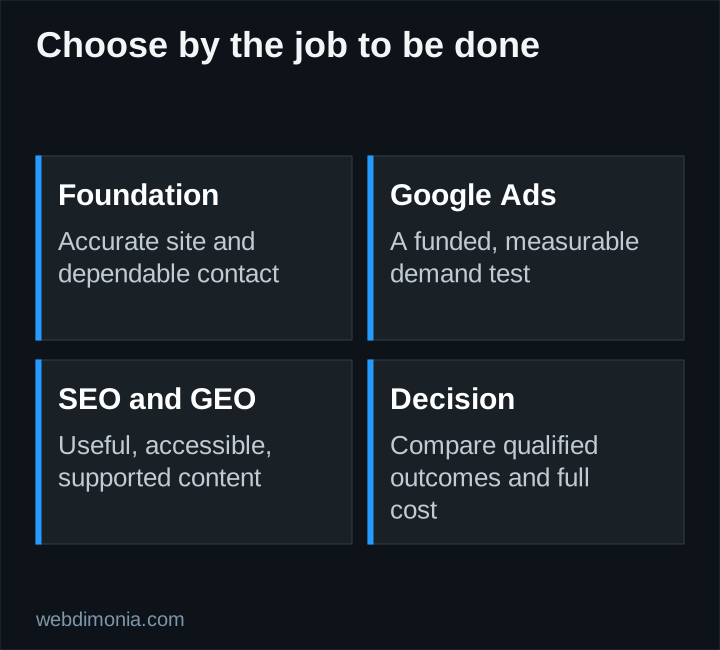
For an agency with limited cash and an incomplete site, prioritize the highest-impact repairs and accurate local presence. For an agency ready to test demand, reserve a bounded paid budget while continuing useful organic maintenance. For an established campaign, use qualified-outcome data to decide whether another dollar belongs in media, page improvement or a different service.
Review the channels together, but report their costs and outcomes separately enough to make decisions. An existing customer searching the agency name is different from a new prospect finding a service guide.
There is no honest universal winner. The better choice is the next investment that addresses the agency's actual constraint and can be evaluated without putting the business under unnecessary cash pressure.