Ask the people answering your agency's phones what they explained three times this week. That's a better starting point for content than a blank calendar with twenty blog slots to fill.
Some answers belong on an existing office or service page. Others deserve a checklist, an article or a short social post. This plan helps you choose the right home for each question and gives the office a manageable review schedule.
Collect questions from the people who answer them
Ask staff to record recurring questions without including customer names, policy details or other private information. Review approved email templates, call themes and existing page gaps. Group questions by what the person is trying to accomplish.
Examples might include what to bring to a quote conversation, how to reach the right office, what happens after an online request or which channel to use for an existing policy. These can be answered from the agency's own verified process without inventing broad insurance advice.
Have an appropriately qualified reviewer handle topics about coverage, exclusions, legal requirements or product availability. A marketing writer should not turn a general article into unsupported policy advice.
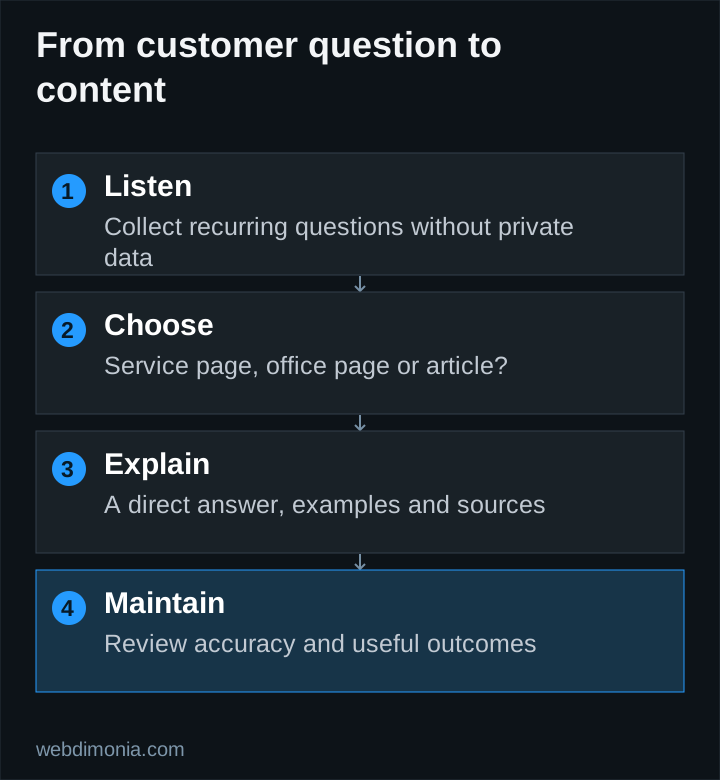
Match the question to the right page type
| Customer need | Usually useful format | Why |
|---|---|---|
| Understand an available service | Service page | Explains the offering and contact path |
| Find or visit an office | Location or contact page | Keeps practical facts easy to maintain |
| Understand who will respond | About or team page | Establishes real identity |
| Prepare for a conversation | Article or checklist | Provides a reusable explanation |
| Get a short office update | Social post or profile update | Communicates a timely fact |
Before drafting, search your own site. If a page already answers the same question, improve it rather than publishing a competing version under a slightly different title. Keep one main destination for each clear intent.
Use a practical topic brief
Write the audience, the question, the short answer, the required facts, the reviewer and the next step. Add the source of any external claim and the date it was checked. List the internal pages the article should link to.
A brief for “what to prepare before calling our office” could identify the type of conversation, information the office actually needs and information that should not be sent through a public form. It should end with the appropriate contact route, not a generic sales paragraph unrelated to the topic.
Use diagrams when they explain a process. Use real photographs when identity or place matters. Keep the key answer in page text as well, so it does not depend on an image being visible.
Plan the first 90 days around useful work
This is an example workflow, not a required publication quota.
| Period | Main work | Concrete output |
|---|---|---|
| Weeks 1–2 | Audit facts, pages and recurring questions | A prioritized list and named reviewers |
| Weeks 3–4 | Improve core service and office information | Updated pages with working contact paths |
| Weeks 5–6 | Publish one preparation guide | A reviewed article and a short derivative post |
| Weeks 7–8 | Answer the next distinct question | Another useful resource or an existing-page update |
| Weeks 9–10 | Review search and inquiry feedback | Corrections, missing links and a revised brief |
| Weeks 11–12 | Publish or improve the highest-value gap | A maintained resource, not content for its own sake |
The cadence should fit review capacity. Four carefully checked pieces can be more useful than twelve rushed posts. A larger library is justified when the topics are distinct and the team can maintain the facts.
Write answers that stand on their own
State the answer early, then explain conditions, examples and the next action. Use descriptive headings. Avoid padding the introduction with broad statements about how important insurance is.
Where a claim depends on a source, link near the claim. Distinguish agency procedure, general explanation and hypothetical example. Do not add statistics merely to make the article look authoritative.
Google's people-first content guidance emphasizes usefulness to the intended audience. For AI-search visibility, the same clarity helps make the information understandable, but it does not guarantee a citation. See our GEO guide.
Connect articles without forcing keywords
Link a preparation article to the relevant service and contact route. Link a location explanation to the real office page. Use descriptive anchor text that tells the reader what they will find.
Avoid inserting every carrier, city and coverage term into every article. That weakens the explanation and creates claims the agency may not be able to support. Do not build hundreds of near-identical city or product pages from one template.
Measure and maintain the plan
Review which questions produce relevant impressions, visits and useful inquiries where those measurements are available. Also ask staff whether the resources help customers prepare or reduce repeated explanations. Keep those observations separate from claims of attributable sales.
Assign review triggers for office changes, product changes and external policy updates. Use a meaningful updated date when the content changes. A maintained plan should improve what the agency knows and publishes over time, rather than leave a trail of outdated articles.
For short-form distribution, use the social content calendar. Website publishing and social posting can support each other, but they are different deliverables and should be scoped separately.