A $3,000 budget can mean two very different things: $3,000 paid to Google, or $3,000 to cover Google and the person managing the account. Sort that out before looking at click forecasts.
Then ask what a new customer is worth to the agency over a period you can afford to wait. The examples below show how media spend, management fees and inquiry quality fit together. Replace the performance assumptions with your own numbers before making a spending decision.
Start with contribution, not written premium
Written premium is not the money your agency keeps. For a planning model, estimate the revenue the agency expects to receive over a defined period, then subtract the variable costs associated with serving that business. Use your actual compensation arrangements and expense records.
Choose a timeframe you can defend. Expected renewals may matter, but do not finance today's test with an optimistic lifetime-value figure that ignores retention, servicing and the delay before cash arrives.
A simple planning ceiling is: allowable acquisition cost equals expected customer contribution minus the profit you want to preserve. That is a business decision, not a Google Ads setting. If the inputs are uncertain, model a range and start with a smaller commitment.
Add all acquisition costs
| Cost | Include in the plan |
|---|---|
| Media | What Google charges for ads |
| Management | The agency or employee cost of running campaigns |
| Setup and pages | Agreed one-time work, allocated over a stated period if appropriate |
| Tools | Relevant call, reporting or integration costs |
| Sales handling | Additional variable cost of working the inquiries |
Webdimonia's published management floor is $1,499 per month, plus 5% of monthly ad spend above $15,000. Ad spend is separate; extra scope can increase a quote. The fees guide explains the distinction.
If your entire monthly allowance is $3,000, that does not leave $3,000 for Google after management. At the published base fee, it leaves $1,501 before any other costs. Make this distinction before evaluating whether the planned media test is large enough for the questions you want to answer.
Work through a hypothetical campaign
The following numbers are invented for planning. They are not insurance benchmarks, a forecast or Webdimonia client results.
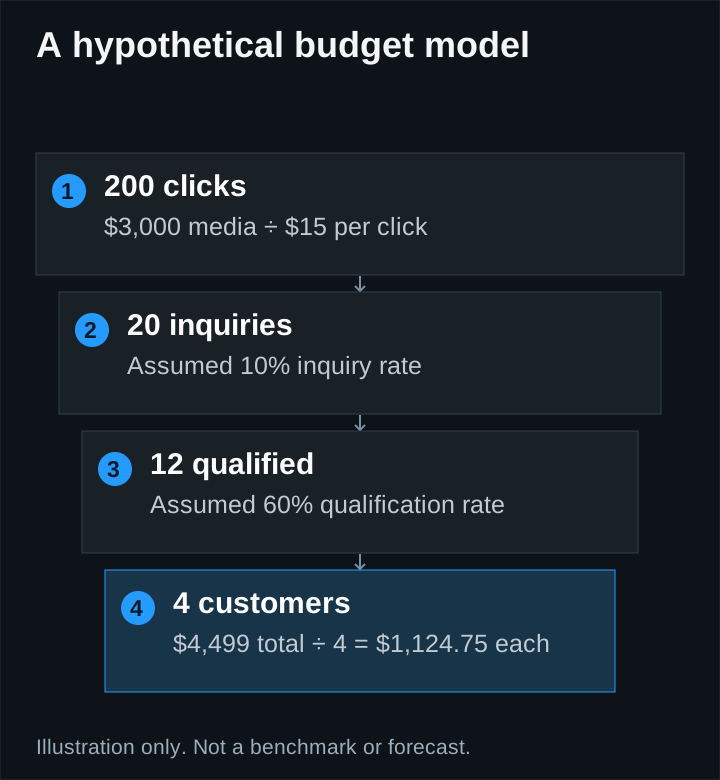
Assume $3,000 in media, the $1,499 base management fee and no additional costs in this simplified example. Assume clicks cost $15, one in ten clicks becomes an inquiry, 60% of inquiries qualify and one third of qualified inquiries become customers.
| Stage | Calculation | Hypothetical result |
|---|---|---|
| Clicks | $3,000 ÷ $15 | 200 |
| Inquiries | 200 × 10% | 20 |
| Qualified inquiries | 20 × 60% | 12 |
| Customers | 12 × one third | 4 |
| Total acquisition cost | $3,000 + $1,499 | $4,499 |
| Cost per customer | $4,499 ÷ 4 | $1,124.75 |
If contribution over the chosen period is $1,000 per customer, four customers produce $4,000 of contribution against $4,499 of acquisition cost. The example falls short by $499 before any omitted costs. A dashboard showing twenty conversions would not change that conclusion.
See how customer count changes the result
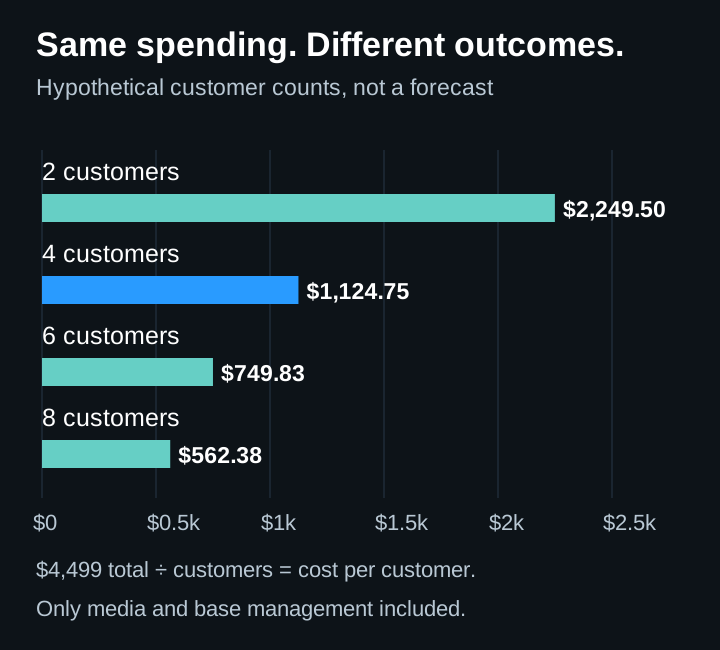
Hold spending at $4,499 and vary only the number of customers acquired. The difference is large even though the ad report could show the same clicks and initial inquiries.
| Hypothetical customers | Total acquisition spending | Cost per customer |
|---|---|---|
| 2 | $4,499.00 | $2,249.50 |
| 4 | $4,499.00 | $1,124.75 |
| 6 | $4,499.00 | $749.83 |
| 8 | $4,499.00 | $562.38 |
At two customers, the cost per customer is twice the four-customer case. That's why inquiry quality and office follow-up belong in the review alongside click prices. The chart doesn't predict which outcome your agency will achieve.
Stress-test the assumptions
Change one input at a time. At the same spend and click cost, a lower inquiry rate reduces the opportunities available to the office. If inquiry quality drops, an apparently attractive cost per form can still produce an expensive cost per customer.
Also test a slower sales cycle. An inquiry received this month may not become a customer until later. Review both the month in which spending occurred and the eventual outcomes of that group of inquiries. Do not divide this month's spend by unrelated sales from earlier campaigns.
The model tells you which uncertainty matters most. If qualification is unknown, prioritize staff review. If the page's inquiry rate is unknown, verify tracking before interpreting a low number. If contribution is unknown, solve that business input before scaling.
Translate the monthly media plan into account settings
Google uses average daily budgets. For most campaigns, its spending-limit documentation describes a daily limit of up to twice that average and a monthly limit based on 30.4 times the average daily budget. Budget changes and campaign types can affect the calculation.
A daily average is therefore not a strict daily cash cap. Check the account's budget report and billing setup, and do not assume that limiting ad hours automatically lowers the monthly limit.
Decide the test rules before launch
Write down the maximum total spend, the minimum evidence you need, who reviews inquiry quality and what would trigger a pause. Avoid changing targeting, page design and bidding simultaneously unless an urgent problem requires it; otherwise you will struggle to understand the result.
Raise the budget only when the agency can handle the additional volume and the economics remain acceptable. Read Google Ads vs SEO if the cash available for a meaningful paid test is limited. The right budget is one the business can evaluate and sustain, not a number chosen to match another agency's spend.