
If one Google Ads proposal quotes $500 a month and another quotes $3,000, first check whether they're pricing the same thing. One may cover management while the other includes money paid to Google. Landing pages and setup can sit outside both.
Here is how our fee works, followed by the questions we'd use to compare any proposal. The useful number is the complete cost for the scope your agency needs.
How Webdimonia prices management
Google Ads management is 10% of total monthly ad spend. There is no base fee, minimum or spend threshold, and no long-term contract. The agreement covers paying each month's fee at the end of the month. Ad spend itself is paid to Google, and the management fee sits on top of it.
For example, $20,000 of media spend produces a $2,000 management fee, for $22,000 combined. This illustrates the fee rule; it is not a recommended media budget or a performance forecast.
New landing pages and website work are quoted separately. Use current pricing and the Google Ads service page to confirm the published offer, then agree the actual scope in writing.
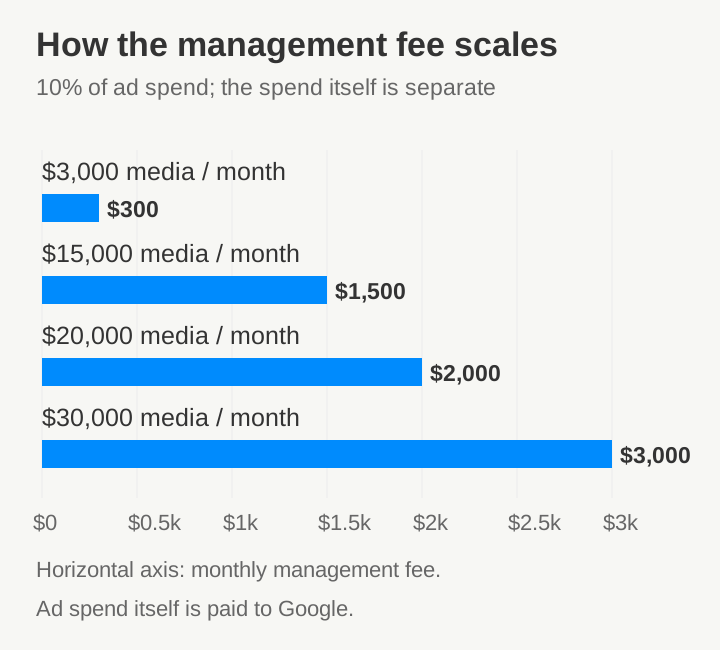
| Monthly media spend | Management fee | Combined monthly amount |
|---|---|---|
| $3,000.00 | $300.00 | $3,300.00 |
| $15,000.00 | $1,500.00 | $16,500.00 |
| $20,000.00 | $2,000.00 | $22,000.00 |
| $30,000.00 | $3,000.00 | $33,000.00 |
Identify what ongoing management includes
Webdimonia's published scope covers campaign setup and ongoing management, branded and local-intent search campaigns, keyword research, ad copy and testing, optimization toward qualified leads, call tracking and the AI-qualified call leads built into Google Ads. Where an agency's systems allow it, we also track website conversions, forms, CRM pipeline, quotes and policies. We cannot guarantee tracking of quotes or policies completed inside carrier-controlled systems we cannot access.
The useful comparison is how those activities will be applied to your agency. Ask which products and locations are included, what approvals are required and how campaign changes are reviewed. A list of generic services is not a substitute for an agreed plan.
Do not assume that unlimited new landing pages, extensive website development or every third-party tool is included in a monthly fee. Name any separate work before signing so the campaign does not launch with an unresolved dependency.
Compare fee models using the same scenario
A provider may quote a flat retainer, a percentage of spend, a base-plus-percentage model or a broader package. Ask each provider to calculate the total for the same proposed media budget and scope.
Clarify minimums, thresholds, setup charges, cancellation terms and what happens when spending changes. If pricing depends on leads or outcomes, define those terms carefully and explain how duplicates, ineligible inquiries and attribution disputes are handled.
A provider's pricing model does not establish that the campaign will be profitable. Use the agency's contribution and reviewed outcomes to evaluate that question separately.
Build a complete monthly worksheet
| Budget item | What to record |
|---|---|
| Advertising | Approved media allowance paid to Google |
| Management | Fee or percentage of spend and agreed extras |
| Initial work | Setup or page work that is separately quoted |
| Tools | Call, reporting or integration costs where required |
| Office handling | Staff responsibility and relevant additional cost |
If the total available budget is fixed, subtract non-media costs before choosing the amount for Google. A $3,000 all-in allowance is not a $3,000 media budget plus a manager. The budget guide works through this distinction with labeled hypothetical numbers.
Make account access part of the proposal
Confirm who owns the advertising account, who has administrator access and who pays the platform. The agency should understand how provider access is granted and removed, and what remains available if the engagement ends.
Ask about access to landing pages, analytics, conversion definitions and reporting history. Avoid a situation where the only explanation of performance is a screenshot the provider chooses to send.
This does not require the owner to manage the campaign personally. It requires a clear operating relationship and a usable handoff if responsibilities change.
Agree on what a useful result means
A button click, captured form, connected call, qualified inquiry and customer are different stages. Decide which events are measured automatically and which need staff review. Do not accept a report that labels every interaction as a lead.
The tracking guide explains the measurement plan. The report template shows how to connect cost and quality to the next decision.
Ask how irrelevant searches, missed calls and unreviewed inquiries will be handled. Campaign management and office follow-up depend on each other; neither should become an excuse to ignore a visible problem.
Choose the scope you can fund and evaluate
Before launch, confirm the approved services, destination pages, total test limit and review conditions. A quote should make the work concrete enough that the owner can judge whether the test is affordable.
Start a project conversation with the agency's current site, intended services and budget so the first proposal can address the actual situation.