At the end of a marketing review, you should know what to keep doing, what to fix and what to stop paying for. A report that only shows impressions and green arrows leaves those decisions to guesswork.
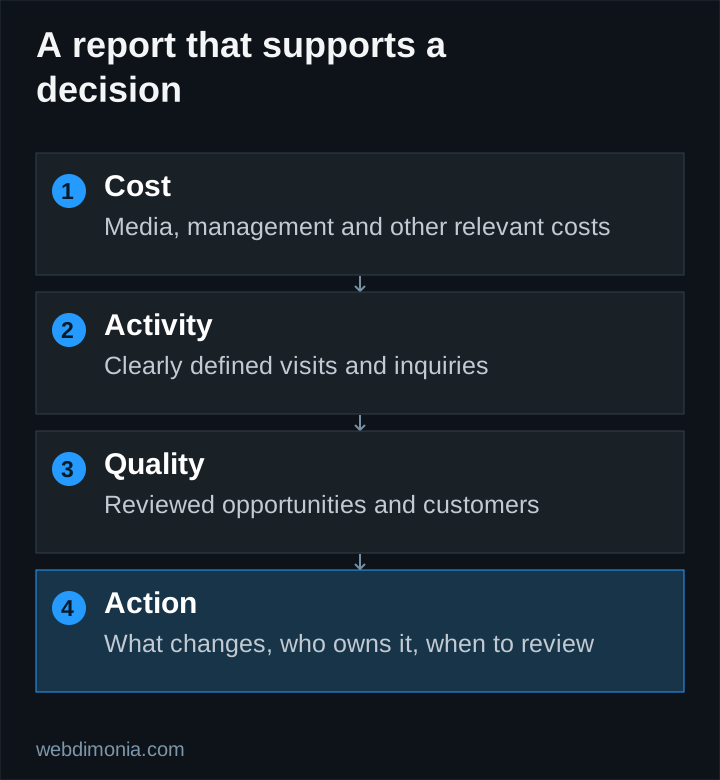
Keep the owner-facing report short. Show spending, received inquiries, reviewed quality and the next action. Leave room for “not yet known” when the office hasn't finished reviewing a lead or a sale takes longer to close.
Start with the decision, then the numbers
Open with the reporting period, work completed, major changes and the decision the evidence supports. That might be continuing the current test, fixing a broken page, narrowing an irrelevant query group or holding spend while the office reviews outstanding inquiries.
State what remains uncertain. For a new campaign, there may be too few reviewed outcomes to justify a strong conclusion. If tracking changed during the period, explain the break in comparability rather than presenting a simple percentage increase.
A useful opening could read: “The campaign produced captured inquiries, but several are still awaiting staff review. We are holding the budget while completing qualification and checking the search terms associated with unsupported products.” That is an example of report language, not a Webdimonia client result.
Show a complete cost view
Separate media, management, one-time work and relevant tool costs. If a report calculates return using media alone, label that limitation clearly. The owner needs the full acquisition cost to make a funding decision.
Use the same period for the numerator and denominator, or explain why they differ. A campaign cohort may need time to mature before its sales are known. Do not divide this month's spend by all business written this month if some of that business came from unrelated sources.
The budget guide provides a hypothetical model. Replace its assumptions with the agency's records rather than importing the example numbers into the report.
Use a stage-by-stage scorecard
| Measure | Definition to agree | Decision it can inform |
|---|---|---|
| Spend | Actual cost by category and period | Whether the test stays within its limit |
| Relevant visits | Visits to the intended destination, with source limitations noted | Whether the campaign reaches the page |
| Captured inquiries | Confirmed received requests, deduplicated appropriately | Whether contact is happening |
| Qualified inquiries | Requests staff reviewed against agreed criteria | Whether the audience fits |
| Quotes | A consistently defined quoting milestone | Whether opportunities progress |
| Customers | Confirmed outcomes attributed with stated limits | Whether economics appear viable |
Keep counts and rates together. A percentage based on very few events can swing sharply. If the denominator is zero or unavailable, show that rather than manufacturing a rate.
Report channels without pretending they are identical
For Google Ads, include search relevance, spend, conversion definitions and qualified outcomes. Separate agency-brand activity where it helps distinguish existing demand from new-audience acquisition.
For organic search, review relevant queries, useful landing pages and observed inquiry paths where data is available. A ranking for an irrelevant phrase is not an achievement worth optimizing around. New pages may take time to be discovered, and publication does not establish indexing.
For social publishing, show the approved work delivered and the useful interactions it generated. Keep reach, engagement, website visits and inquiries separate. For Google Business Profile, use Google's metric definitions; a call-button interaction is not necessarily a completed conversation.
For AI-search observations, record the product, query, date and cited URL. Do not turn a handful of manually checked answers into a universal market-share figure. The GEO guide explains that limitation.
Include inquiry-quality reasons
Ask the office for a small, consistent set of outcome labels. Wrong territory, unsupported product, duplicate, existing customer, no contact established, quoted and won each suggest different actions.
A broad “bad lead” bucket hides the distinction between targeting problems and follow-up problems. Review a sample privately with the people who handle inquiries, then report aggregated patterns without exposing names, phone numbers, policy details or freeform messages.
The tracking guide describes how to keep general analytics separate from customer records. A marketing report should not become a duplicate customer database.
End with an action log
List the proposed action, its reason, its owner and the condition for reviewing it. “Improve performance” is not an action. “Repair the mobile form error, verify capture, then reassess inquiry rate” is.
Keep a record of completed changes and their dates. Avoid changing several major variables at once unless a clear failure requires it. Otherwise, the next report may show a difference without explaining what caused it.
A useful report makes uncertainty visible and supports the next business decision. It should be understandable to the agency owner, traceable to defined measurements and honest about what the data cannot establish.