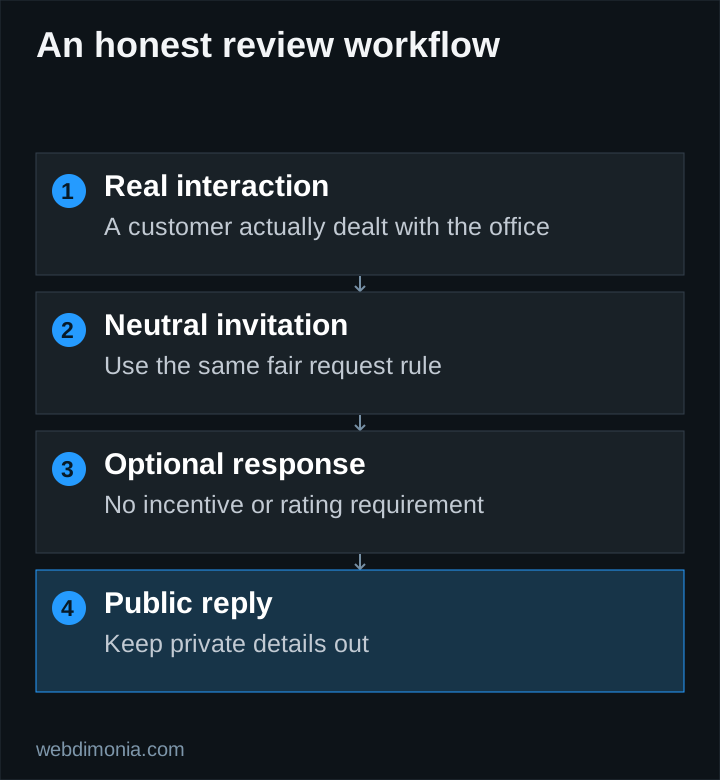
Make it easy for a customer to leave an honest review after dealing with your office. Send them the direct review link, keep the request brief and let them choose what to say.
Don't attach a reward or filter the request so only happy customers reach Google. The process should produce a record of real experiences, including feedback you'd rather not receive.
Choose a fair moment to ask
Pick a normal service milestone that reflects a real interaction, then apply the request rule consistently. For example, the office might invite feedback after a completed service conversation, subject to its communication permissions and internal requirements.
Do not make the invitation depend on a private satisfaction survey. Sending happy respondents to Google while directing unhappy respondents only to a private form is review gating, not a neutral feedback process.
Give customers room to decline. Staff can make the request available without demanding an immediate response, watching someone type a review or repeatedly pursuing a person who has ignored it.
Use the actual review link
Google explains how businesses can share a review link or QR code. Confirm that the link opens the correct office profile before using it in an email, printed card or approved follow-up message.
For a multi-office agency, label the destination clearly. Avoid sending a customer to a location they did not deal with simply because another office has fewer reviews. Keep the link in an approved template so staff do not improvise or accidentally use a competitor's listing.
Adapt these neutral templates
Email request:
Thank you for speaking with [agency name]. If you would like to share your experience with our office, you can leave an honest Google review here: [review link]. Please avoid including policy numbers, claim details or other private information. Thank you for your time.
In-person request:
If you would like to share feedback about your experience with our office, this card links to our Google reviews. It is completely optional.
Follow-up after a service interaction:
We appreciate the chance to help. You are welcome to share an honest review of your experience at [review link]. Please keep private account information out of the review.
Replace the brackets and have the agency review the wording and communication channel before use. These are writing examples, not permission to email or text people without the applicable consent or relationship.
Know the boundaries before setting targets
Google's Maps contribution policy prohibits incentivized reviews, fake experiences and selective solicitation of positive reviews. Do not offer gift cards, discounts or prize entries in exchange for a Google review, even if you say the review may be honest.
Avoid staff competitions that encourage pressured or prescribed review content. Do not ask customers to include a particular employee name, coverage term or city keyword to manipulate the review. Let them describe their own experience.
The FTC's review-rule guidance addresses fake reviews and other prohibited practices. Platform rules and legal requirements are not identical; satisfying one does not establish compliance with the other. Keep the operational rule simple: authentic experience, no incentive, no rating filter and no pressure.
Respond without exposing customer information
A positive review can receive a brief thank-you without confirming the person's products, policy status or private circumstances. For a negative review, acknowledge the concern and offer a suitable private contact route.
An example is: “Thank you for sharing your concern. Please contact our office at [public phone] so we can discuss it directly.” Adapt the wording to the situation; do not paste the same robotic response everywhere.
Avoid arguing about a claim or quoting internal records. Even if the reviewer disclosed something publicly, the agency should not add private details to defend itself. If a review appears to violate platform policy, use the appropriate reporting process rather than promising that a vendor can remove it.
Measure the process without distorting it
Track whether the approved invitation was available at the selected milestone, whether the link works and whether staff respond appropriately. Review the substance of feedback for recurring operational problems.
Do not treat review count as a substitute for customer service or a guaranteed ranking mechanism. A sudden burst created through pressure is not evidence of a better business. Avoid attributing a change in calls entirely to reviews when ads, seasonality, profile changes or other factors also changed.
Use the marketing-report guide to keep visibility, interactions and business outcomes distinct. If reviews reveal that customers cannot reach the office, fix the contact experience before asking for more public feedback.
Maintain the workflow
Assign an owner to the templates, link and response process. Recheck the destination after profile changes, and train new staff on the neutral request rule. Keep the process straightforward enough that the office can follow it consistently without turning every customer conversation into a review request.